



THE NESHTOPHONE
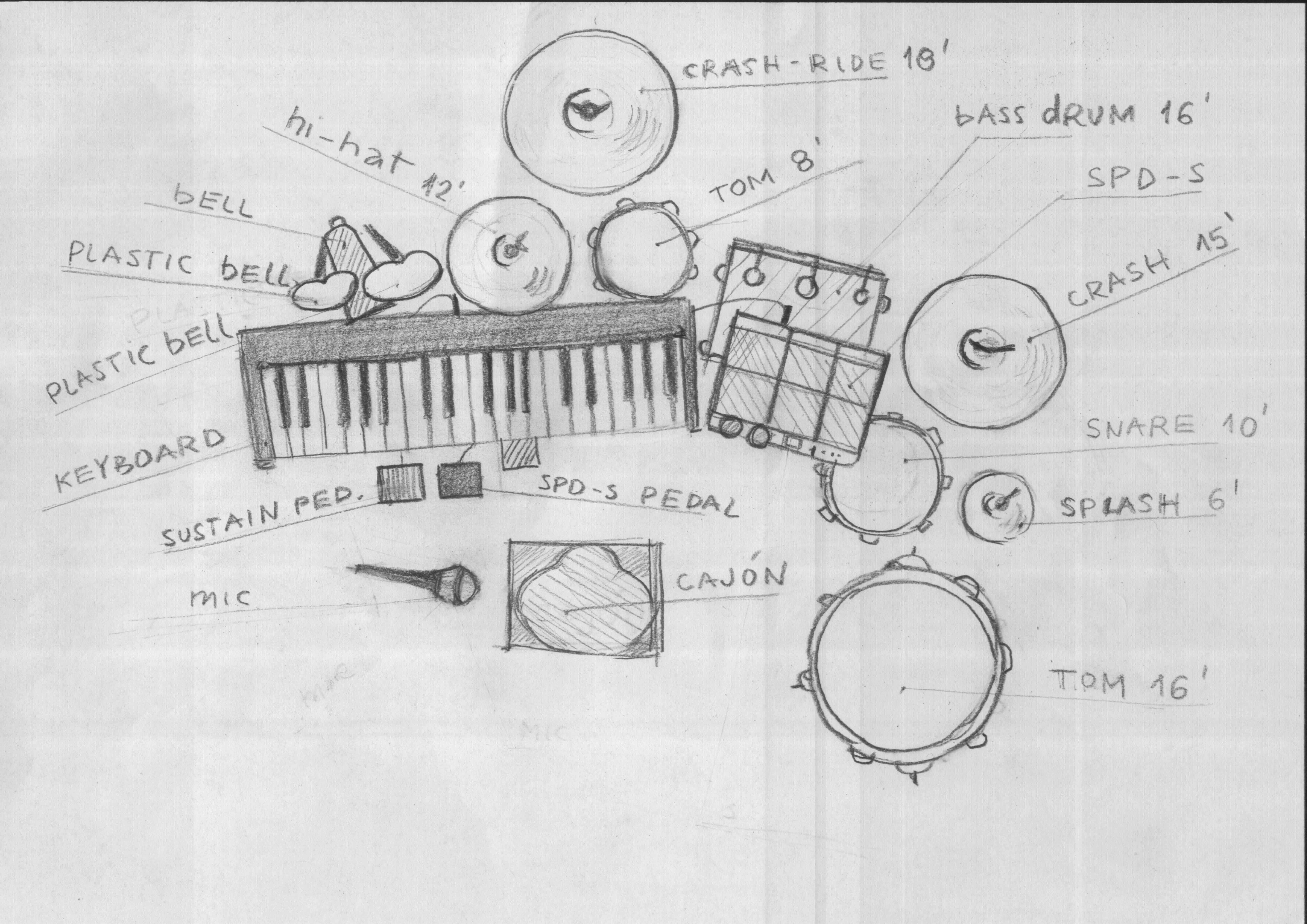
The invention, creation, patent of Nenad Kojic, the musical innovation Neshtophone, when basically speaking, is a hybrid musical instrument created by merging several different instruments that play music simultaneously, with a subjective impression of a homogeneous unity, a musical instrument, that simultaneously reproduces the entire sound spectrum of a multi-member band.
While observing with regard to more detail, the Neshtophone is an electro-acoustic instrument that contains four musical instruments, among which are:
the Keyboard (which, in addition to its standard use of audio signals, i.e, the sounds contained in the integrated module of the keyboard, is also used as a MIDI controller that provides opportunities for the usage of additional, personalized sounds from the external modules)
Drums (bass drum, snare drum, 8 inch tom, 16 inch floor tom , hi-hat cymbal, crash and crash-ride cymbal).
Percussion (metal and plastic bells, cajon, electronic controller of percussion and sound effects),
The Vocal apparatus (in addition to the instrument above that includes all four limbs, it is possible to simultaneously engage the vocal apparatus regarding singing, onomatopoeia, Foley art, etc.).
Since this instrument has almost limitless possibilities and many ways of playing, it is necessary to specify the basic assumptions and principles of its functioning.
MODUS 1, 2
The left hand is used for playing the keyboards:
• playing the bass lines with the left hand in the register from C0 (~ 16 Hz) to A2 (~110 Hz)
• playing the lines of other instruments, higher registers from A2 (~ 110 Hz) to C7(~ 20 KHz)
• combined playing of all the registers from 16-20000 Hz (in order for the specified access to this fragment of the Neshtophone to be meaningful and to exploit the full potential of the keyboard, a function called. “splitting” is used, practically defined as a “division” of the keyboard into different wholes. This principle, therefore the way of programming is applicable at the level of individual keys, octaves, a certain number of tones, i.e, the desired partition or tonal sequence.
For example:
– The sound of a bass guitar is assigned to the octave from C0-C2, while the remaining keys from # C2 up to the highest remaining to ne is grated the piano sound. This option is effective as more complicated programming as well, providing each key of the keyboard a special, unique sound, a sound effect for the sake of a more complete interpretation of the desired composition)
The right hand is used to play the drums – also only one or more elements, at the same time using drumsticks [regular, brushes or playing the “cajón” with the hand (a percussive element of the Neshtophone where you sit), percussion or any other element of the drum)]
The left leg as the limb that benefits:
• The hi-hat cymbal (opening and closing the cymbals by pressing the pedal)
• The “sustain” pedal that is used for the extension of the desired tone reproducing the keyboard
• The pedal that is associated with the electronic controller and can trigger any sound – any “sample” which was previously assigned to the controller
The right foot moves the bass pedal that hits the bass drum.
The Vocal apparatus is used for singing, Foley art effects (imitation). Using a microphone (electro-acoustic converter) the vocal lines can be:
• raw, realistic features
• stylized features, processed in real time using the appropriate processor modules, effects, and so on.
MODUS 3
The right hand is on the keyboard and uses the whole octave range and possibilities of the same.
The left hand is used to play the drums – also only one or more elements, at the same time using drumsticks [regular, brushes or playing the “cajón” with the hand (a percussive element of the Neshtophone where you sit), percussion or any other element of the drum)]
The Vocal apparatus is used for singing, scat singing and Foley art effects (imitation). Using a microphone (electro-acoustic converter) the vocal lines can be:
• raw, realistic features
• stylized features, processed in real time using the appropriate processor modules, effects, and so on.
MODUS 4
Both hands are positioned on the keyboard and used the same as when playing the classical piano.
The legs are used to manage all the pedals including the bass pedal, hi-hat cymbal pedal, the “sustain” pedal that is used for the extension of the desired tone reproduced using the keyboard, the pedal that is associated with the electronic controller and can trigger any sound – any “sample” which was previously assigned to the controller
The Vocal apparatus is used for singing, scat singing and Foley art effects (imitation). Using a microphone (electro-acoustic converter) the vocal lines can be:
• raw, realistic features
• stylized features, processed in real time using the appropriate processor modules, effects, and so on.
There are many definitions of creativity. Etymologically speaking, the root of the word in Serbian and some of the European languages comes from the Latin word “creatus”, which literally means “who grew up”. Probably the most widespread conception of creativity in the scientific literature is that creativity is manifested in every creation of a creative work (eg by creating a new work of art or a scientific hypothesis), which is both original and useful.
In The Act of Creation, Arthur Kestler lists three types of creative individual – The Artist, The Sage, and The Joker. Judge for yourself which category the innovator Neštofon belongs to.
